In the Attention Economy, We’re All Cheap
It might be worth arguing that the most boring form of online discourse is discourse about discourse – but that’s basically all I did for my time in academia and I never quite grew out of the “thinking too much about every possible thing” angle, so here I am I guess.
If pressed to identify the most consistent feeling I’ve had about myself throughout my life, it might have to be the feeling of being “othered.” I was a geek, I was queer, I wasn’t athletic, oh wait geek is cool now and I’m not nerdy enough about the right things anymore, I was squeaky, I was artsy, I was too bad at competitive video games, I wasn’t squeaky anymore but now I must be faking my voice (that claim never went away), now I’m too good at competitive video games and it’s not fun for everyone if they can’t dunk on me anymore, I wanted to pursue online media as a career instead of going into engineering, and I had undiagnosed ADHD underwriting many otherwise inexplicable personality traits.
I’ve wanted, yearned to belong to “something bigger than myself” but rarely does anything pass the “sniff test” of a skeptic and someone who doesn’t buy-in, and being opinionated leads to conflict; conflict leads to friction, friction leads to othering.
As a result, I’ve cultivated this life and career for myself where I have one foot in the door of many, many different outlets and mediums and potential lines of work. (I guess I have a lot of feet.)
So naturally, I’m at my most uncomfortable when the various different scenes that I try to partake in are at odds with each other. (Which is… basically all the time. Flame wars never truly died on the net, it just stopped being cool to refer to them as such.)
Frequently this comes up by way of mocking a specific individual (or category, niche, community, [insert grouping here] of individuals) for doing something online “for attention.”
I would argue that there is nothing more hypocritical than accusing someone on social media of being attention-seeking. It might be impossible to be any more hypocritical. Yet it happens frequently, pervasively, and often righteously. For a certain demographic (or perhaps for all demographics when struck in the right mood) there can be nothing more “cringe” or worthy of shame than to do something online for attention.
Except… wait… then just log off.
This kind of complaint is lodged against online “creators” of all kinds and fields. Whether you post selfies or food pr0n to Pixelfed and Instagram, or you’re a writer, a video creator, an editor, a streamer, an artist, a reporter, an educator, a vlogger or a blogger, a debate bro or a sex worker – someone somewhere is complaining that you “only said” X thing or “only did” Y thing “for attention.”
This feels righteous and just when it’s said of “bad people” – but they’re saying it about “us” too. We’re all playing the same game here, even those of us who aren’t making any money off it.
If you make your career via public, published work, you’re doing the thing for attention. Period.
You may not, personally, want direct attention or eyes on you, specifically – but you are doing things for attention in an attention economy. If you did not want attention on you, your work, or some result of your work, you would not be posting it on the public web.
You may very well – and most likely do – have higher goals and objectives than just “attention” (virtually everyone does) but attention is the currency being spent and the vehicle by which you have to achieve your goals, regardless.
Perhaps it’s my history of bullying; perhaps it’s the shame of not pursuing one single career path and being “bought in”; perhaps its my hyper-empathy that extends even to my worst enemies; perhaps it’s my chronic case of never successfully belonging to a bigger group that I was not the leader of. But when I see someone mocked for attention-seeking as an inherent part of their online work, I feel gross and slimey all over.
It’s easy to write this behavior off as the “pot calling the kettle black” and all – but who am I to make fun of someone else with that as my basis, when that’s just as easily flipped on me by my own naysayers? I sure as hell don’t want that being said about me.
I don’t want attention. I mean, not directly, not really. I’m a pretty shy person, a private one. I’m not friendly in person unless I “have to be” for professional reasons. I’m not going to be a dick, but I’m going to avoid drawing attention and avoid direct contact. I have always wanted my work to speak for itself and hold a massive disdain for the more parasocial requirements of my job. I don’t want that, but I arguably have to cultivate that to some degree in order to sustain my work. It’s gross, I don’t like it, but it’s a part of the job. And I do my best to not put others down for leaning into it – in a non-harmful, not-abusive manner, mind you (which some people seem to find pretty difficult for some godsforsaken reason…) - when they’re just doing a better job at “securing the bag” than I am. I actively throw away financial (and other metrics-based) success because I don’t want to play that game.
But it’s still my job. For all of my hermiting, my focus on the work, my desire to not put myself out there and invite you in to care about “me” – that’s an inherent requirement to building a following, getting clicks, getting work.
I see this stone-casting behavior most frequently in two distinct scenarios. The first is on a miserable place, but perhaps still indicative of the clique-esque behavior at play: Reddit. The various photography subreddits (all of which have their own inter-Reddit conflicts and infighting) see “photography YouTubers” as nothing but gear hawkers, people who don’t actually shoot, those who aren’t working professionals or “real artists.” And honestly, it’s easy to see why. But they’re not all that way.
The other angle comes in the sneering that goes on between the various groups of “games media.” Writers versus YouTubers, reviewers versus streamers, long-form video essaysists vs medium-form(?) videomakers. The tabloid-like, algorithm-chasing, engagement-farming YouTube slop artists versus the clueless, agenda-driven, self-hating game journos. Whatever current terminology is being thrown around this week.
This all makes me super uncomfortable, as someone who wears… all of those hats. I’m a writer, a video artist, I’ve been a streamer and have taught streamers, I’ve made long-form content and I’ve made short-form content. While my goals have been honorable – education being my primary niche and objective for most of my career until the past year or so – the immediate “objective” is, of course, to sustain my livelihood. I have lived and breathed video creation and writing every day of my life since some time in 2002 or 2003 when I first laid hands on a camera (and started writing coherently) – and I want to do everything in my power to continue doing so on my own terms, as long as I maintain my integrity and my focus.
After all, who is a writer to judge if a YouTuber is “algorithm-chasing” or “ad revenue farming” when that’s all written outlets do anyway? Sensationalism plagues all monetized content and until we start self-publishing in ways that don’t seek monetization first, no one’s hands are clean. And who is a streamer to call a “game journo” (maaan I hate that way of saying it, to be clear) clueless or hating games when they, themselves spend most of their time shouting shitty hot takes about games to get the most trendy YouTube Short of the week?
It’s quite amusing that after writing my original thread with thoughts on this, I happen to see Will Borger’s post and Nick Calandra’s subsequent reply vague-posting about some sort of games media drama.
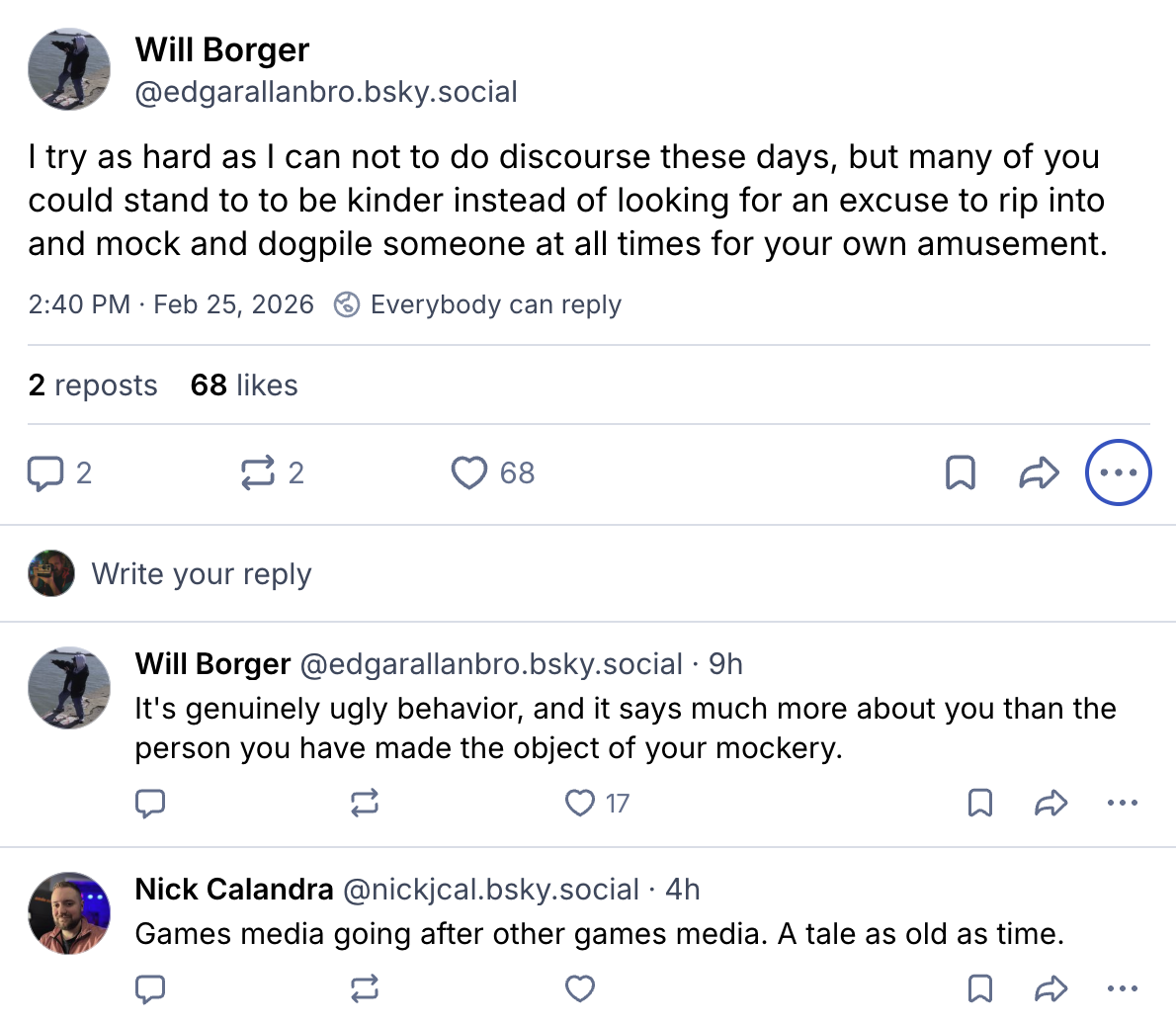
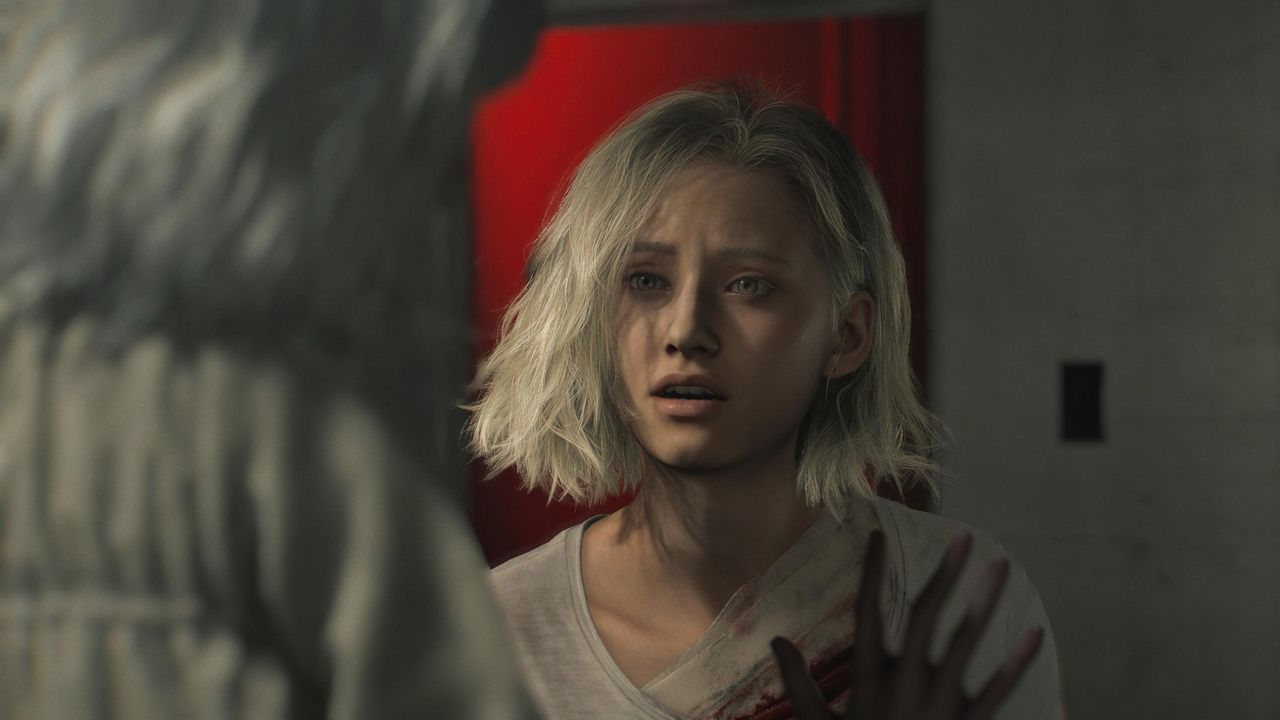
I managed to connect right away that this was (most likely) referring to the social media backlash against Giovanni Colantonio’s Polygon review of Resident Evil Requiem – the conversation was everywhere today, most of it dunking on Giovanni for his… interesting comparison of the atomic bombings of Hiroshima and Nagasaki to Capcom’s latest title. But what stood out to me was that Will’s post could have honestly just as much applied to Nathan Grayson’s piece about Dr. Disrespect’s latest embarrassment.
Now don’t get me wrong – Dr. Disrespect / Guy Beahm is a terrible human being and dunking on him is valid in just about any context, and I consider myself a solid appreciator of Nathan’s work, so I mean no disrespect here. But there was a line (after an already incredible headline) that pulled that similar icky feeling out of me.
“Beahm, a 43-year-old man who despite his age dresses like a clown and yells at video games for a living,” - this is a good line. This is funny. I audibly chuckled upon reading it. But that “yells at video games for a living” as condescension to game streamers still felt icky, in some part of my brain. Again, not in defense of Dr. Disrespect – that is a quite literal description of his content, especially as he further unravels in his radicalization and lost grip on relevance. But because I feel this tension between creators of these differing mediums all the time. Despite having very, very angry feelings towards the subject of this joke, the framing of these “sides” still makes it feel like someone’s pulling my limbs in opposite directions sometimes.
And flip it around, and one could make the same joke that Nathan makes his living writing snarky posts about video game executives and their takes on AI. That’s not a fair assessment, and it’s certainly not how I feel about Nathan’s work or Aftermath’s body of work in the slightest – but if we’re going to start over-simplifying creators in other fields’ jobs to make us feel better about ours, we all end up stepping in shit.
Maybe this is insecurity. Maybe because I never committed 100% to any singular field or direction, I feel like I’m not worthy of hanging with any singular group (or any of the groups at all) so if we’re casting judgement on one group or the other “what does that make me?” rings a bell. Or maybe I just don’t like to see my friends fight. (Again speaking vagueness here as I never want anything remotely resembling an association between Dr. Disrespect and myself.)
Maybe I feel like my involvement in one specific field immediately excludes me from another. What if my participation in the “algorithm-feeding ad revenue-chasing slop machine” of YouTube for much of my career is a reason that more “traditional” games journalists and writers might not take me seriously at some point? That despite a degree in journalism and doing my best to maintain my integrity through the decades that the very condescension cast on those like me immediately ruins my chances?
Or maybe it just takes me back to shitty school-age years where I thought clique-friction was such a petty, stupid way to spend one’s energy – yet it served as a constant reminder that I was in none of them.
None of the broader discourse has anything to do with me, but I feel similar to Will Borger that it looks bad on the people dogpiling when they’re quick to dogpile on someone or on a specific group of someones, even if there’s reasons.
Hell, even within the same “clique” this Resident Evil Requiem review discourse is revealing a lot of in-fighting just in the written games media grouping alone. Lots of people jumping on board for a free dunk – others, like Steven Santana, see it as an opportunity to actually talk about reasonable games critique meta-issues and the pitfalls of some game review processes.
(If we’re going to share hot takes about bad game reviews, I personally think participating in a multi-stage review embargo lift situation at all does a massive disservice to the entire industry and no one should go along with it. But if they didn’t, they’d be giving up the clicks to the next person or breaking trust with Capcom and possibly losing review access. I, myself, once participated in the “unboxing embargo” of a graphics card separate from the actual review embargo primarily just to announce I’d be covering it from my unique angle and get the free views. We’re all cheap.)
I think to a close friend of mine who got a job at Polygon – and other friends who have gotten jobs at Polygon, similarly “ruined” sites, or at big tech companies who are supposed to be the “bad guys.” Should that friend – who had been in a rough financial situation and been grinding away at breaking into the games media world just not have taken the job which massively improved their living situation and got them working with bylines in this industry? Many would say so – and take pot shots on anyone who dares go near Valnet-backed sites or other outlets who laid off staff in any way. What about the individual cost of that?
I don’t really know how to end this. I long to feel like I belong to a group. Tech YouTubers, gaming YouTubers, games writers, tech writers, streamers, podcasters, video artists, analog artists, educators – there’s always something keeping me “out”. I can live with that. I carve my own path. But it doesn’t feel good having specific parts of myself shut down or condescended to because people representing the other parts feel better than.
All of this self-referential bullshit was mostly to serve as illustration of how this might look to others who are reading at home. It’s real, but in line with my “I don’t actually want attention” bit – I’m not trying to make it about me. This is just how I process my overactive mind.
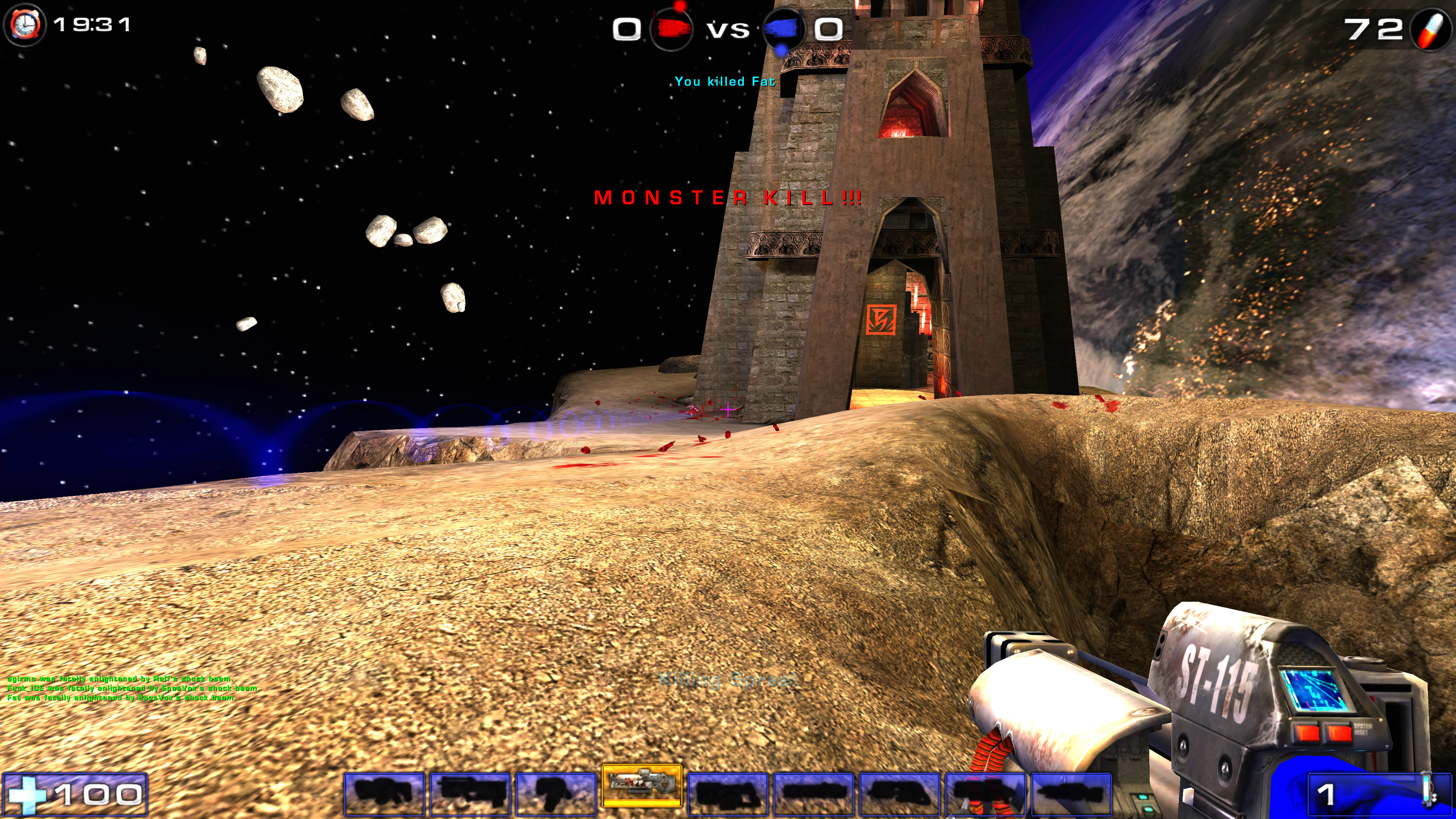
Anywho, duke it out in Unreal Tournament 2004 instead of social media. At this point I’m feeling more gross about being on any social media at this point. One day I’ll be ballsy enough to only post on my own sites and trust auto-posters get the word out. One day.